
Aircraft Selection & Ownership / How Much Luggage Can You Bring on a Private Jet?
How Much Luggage Can You Bring on a Private Jet?
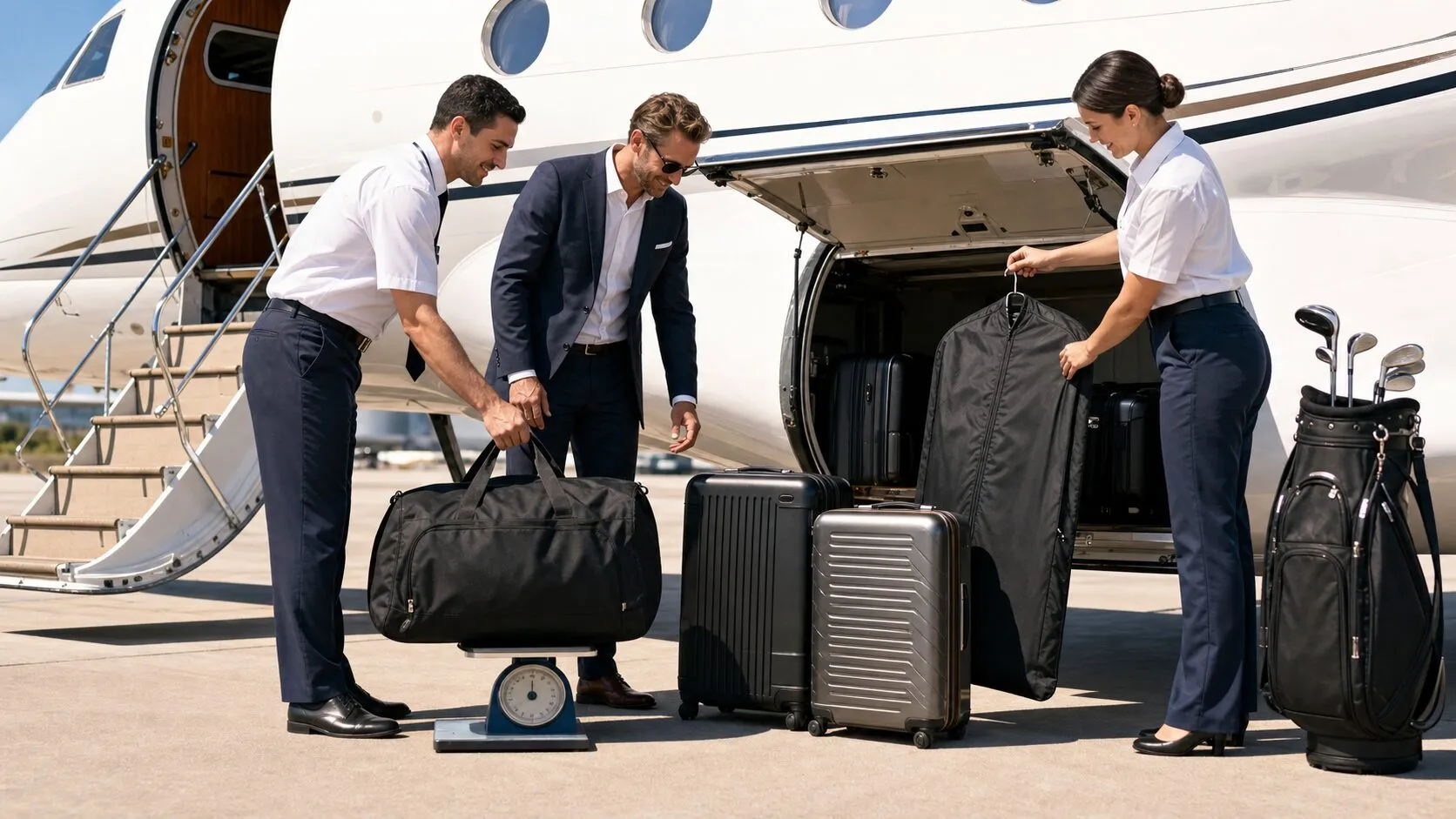
How Much Luggage You Can Bring on a Private Jet
Knowing how much you can pack for private jet flights matters just as much as choosing the right departure time or onboard menu. Even with the privacy, speed, and control that private aviation delivers, every aircraft has real baggage limits that affect comfort, safety, and sometimes routing.
In commercial aviation, you are handed a simple chart: one checked bag, one carry-on, a fee for anything extra. On private jet flights, it is more nuanced. Each aircraft has its own baggage volume, weight limits, and access points. At TruNorth Jets, we work through those details in advance so that your wardrobe, golf bag, stroller, or presentation kit all fit without compromise.
Why Baggage on Private Jets Works Differently
Private aircraft do not follow a standardized baggage policy across the board. Two things set the limits on what you can bring:
- Physical baggage volume, measured in cubic feet, which dictates how many pieces can actually fit
- Weight limits, which include passengers, bags, fuel, and any catering or onboard equipment
Private aviation typically offers more flexibility than commercial first class, especially when you are not flying with every seat occupied. That said, the idea of “unlimited bags” is a myth. On a smaller aircraft flying at full capacity, or a long-range jet departing with full fuel, there will be a practical ceiling on how much you can bring.
Our role at TruNorth Jets is to balance all of this before you ever arrive at the airport. We look at:
- Party size and seating configuration
- Route and range requirements
- Luggage profile, including hard cases, soft bags, sports equipment, and children’s items
Then we pair you with an aircraft category and operator that align with your expectations.
Turboprops: Ideal for Long Weekends and Short Hops
Turboprops are a smart choice for regional business trips and quick family getaways. They typically seat about 6 to 9 passengers and are well suited to short and medium private jet flights where efficiency and access to smaller airports are priorities.
On many popular turboprop models, you can expect approximately 25 to 35 cubic feet of baggage space. As a practical guideline, when the aircraft is near full capacity, plan on:
- About 1 medium checked suitcase per person
- Plus 1 soft-sided carry-on or duffel each
A few luggage nuances matter more on turboprops than larger jets:
- External baggage doors and some interior storage tend to be smaller, so soft bags load more easily than hard-shell cases
- Oversized items like golf bags, skis, or strollers are often possible, but they may require flying with fewer passengers or trimming the overall number of suitcases
- Weight distribution is more sensitive on shorter aircraft, which is another reason soft, flexible bags are often recommended
When your trip is a quick executive hop with modest luggage, a turboprop is often ideal. If that same group adds multiple hard cases, golf clubs, and product samples, that can be the point where we suggest moving up to a light jet so everyone and everything travels comfortably.
Light Jets: Business Essentials and Golf Weekend Ready
Light jets are a natural upgrade from turboprops for 2 to 3 hour private jet flights between major business hubs and resort destinations. Seating typically falls in the 6 to 7 passenger range, and you gain speed and cabin refinement without stepping into a significantly larger aircraft.
Average baggage volume on many light jets is often around 40 to 50 cubic feet. A simple rule of thumb when the aircraft is near full:
- 1 standard checked suitcase per traveler
- Plus a small personal item such as a briefcase, handbag, or compact backpack
A few important points for light jets:
- Most luggage lives in an external hold, so only small personal items are usually accessible in the cabin in flight
- If you have bulky equipment, such as golf clubs, skis, display racks, or multiple garment bags, it may be wise to fly with one fewer passenger or consider a midsize jet
- Pack any in-flight essentials separately, since there is typically no access to the main hold once airborne
For an executive team of four, a light jet often handles roll-aboard bags, laptop bags, garment bags, and a golf set for a combined business and leisure itinerary without difficulty, as long as we plan for it in advance.
Midsize Jets: The Sweet Spot for Business and Family Travel
Midsize jets are often the ideal middle ground for both corporate and family travel. They generally seat 7 to 9 passengers, many offer stand-up or near stand-up cabins, and several are capable of longer coast-to-coast private jet flights on suitable routes.
In terms of baggage, midsize jets commonly offer about 60 to 80 cubic feet of space. As a working average when you are using most of the seats, you can usually plan on:
- 1 large checked suitcase per person
- Plus 1 small carry-on or personal bag each
- Room for a few specialty items, depending on total weight and routing
Practical advantages include:
- Larger baggage doors and more flexible holds that accommodate a mix of hard cases, garment bags, strollers, and sports gear
- More forgiving configurations for mixed-use trips, such as a family traveling with a nanny and a business colleague, each with distinct packing needs
Typical scenarios where midsize jets excel include:
- Families packing for a week at a villa, bringing multiple checked bags, children’s items, and possibly a stroller or portable crib
- Executive groups carrying samples, printed materials, or trade show displays in addition to their personal luggage
When we see a party size and luggage list that would push a light jet to its limits, a midsize option often provides the right balance of comfort, baggage capacity, and range.
Heavy and Long-Range Jets: Pack for Extended Global Itineraries
Heavy and long-range jets are designed for extended, often international, private jet flights where you expect full fuel, generous cabin space, and the ability to bring a more complete wardrobe. Heavy jets typically seat about 10 to 14 passengers and feature true stand-up cabins, often with a flight attendant on many missions. Long-range jets build on that with performance tailored for intercontinental legs.
For heavy jets, baggage volume is typically in the 100 to 130 cubic foot range. A practical planning guide:
- 1 to 2 large checked suitcases per traveler
- Plus personal items such as briefcases, handbags, or small carry-ons
- Additional space for specialty items like golf and ski gear, children’s equipment, or formal wear cases
Long-range jets often have similar or slightly greater baggage volume, but they are more sensitive to weight when the aircraft is loaded for maximum range. When you are planning long oceanic legs at or near full capacity, it is wise to think in terms of:
- Roughly 1 large suitcase per person
- Plus 1 small bag each
- Additional bags potentially available if you are flying with fewer passengers or shorter legs
If everyone in a large party brings multiple oversized hard cases, that can affect how much fuel the aircraft can take and may prompt a fuel stop or a different aircraft selection. Our team works through these details with the operator so you know exactly what is realistic before you finalize your itinerary.
How TruNorth Jets Optimizes Your Aircraft and Luggage Plan
At TruNorth Jets, we treat baggage planning as part of the overall trip design, not an afterthought. Before your flight, we ask specific questions about:
- Number of travelers and how many seats you truly need
- Bag types, such as hard cases, soft duffels, golf bags, skis, strollers, or trade show materials
- Trip length, wardrobe needs, and any special items, from formal wear to delicate equipment
We then coordinate directly with our vetted Part 135 operators to confirm precise baggage limits for the specific aircraft and tail number assigned to your private jet flight. That is where details such as baggage door dimensions, cabin-accessible storage, and actual usable cubic footage become very real factors.
Sometimes the best option is not the smallest aircraft that fits your headcount. For example:
- A lightly loaded midsize jet can be a better choice than a full light jet for a heavily packed family
- A heavy or long-range jet may deliver more peace of mind for extended itineraries with extensive wardrobes, children’s gear, and specialty equipment
When needed, we can also discuss strategies like slight route adjustments, alternative aircraft categories, or ground shipping for certain oversized items, all with the goal of preserving cabin comfort and on-time performance. From car-to-aircraft transfers to discreet baggage handling, our priority is that everything you pack fits elegantly and travels as smoothly as you do.
For a more detailed breakdown of cabin dimensions, luggage capacities, and performance specs across our available fleet, explore theTruNorth Jets Aircraft Guide. It is the perfect resource to help you visualize exactly which aircraft category matches your unique travel and packing needs.
Experience Effortless Private Travel With TruNorth Jets
Choose comfort, privacy, and flexibility by booking your next trip with our tailored private jet flights. We take care of every detail so you can focus on what matters most, whether it is business or leisure. Our team is ready to help you select the right aircraft and schedule on your terms. To discuss your itinerary or request a personalized quote, please contact us.